Scene Optimisation –
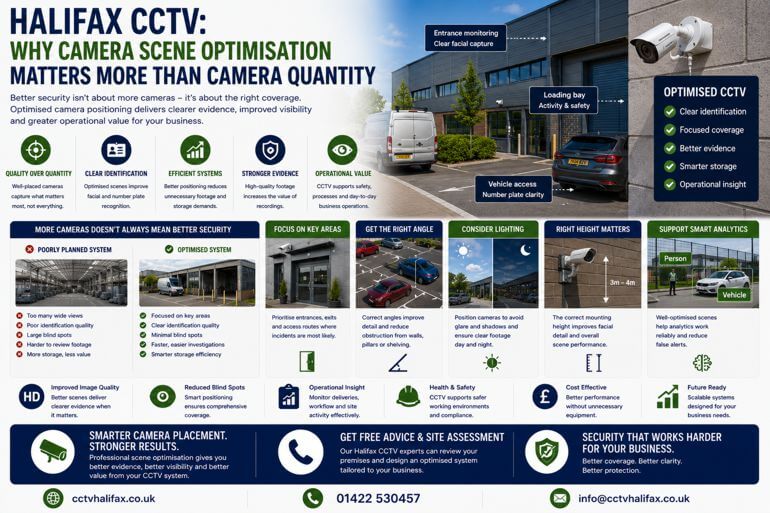
Many businesses in Halifax assume that improving CCTV coverage simply means installing more cameras. While sufficient coverage is important, modern commercial CCTV design increasingly focuses on something far more valuable — camera scene optimisation.
A poorly positioned system with large numbers of cameras may still fail to capture:
- useful identification footage
- clear incident evidence
- or operationally valuable coverage
In many commercial environments, properly optimised camera positioning delivers better results than simply increasing camera numbers.
More Cameras Do Not Automatically Mean Better Security
Commercial premises sometimes install excessive numbers of cameras without fully considering:
- viewing angles
- lighting conditions
- identification quality
- or recording objectives
This can create systems that:
- generate large amounts of footage
- increase storage requirements
- and still fail to provide usable evidence
during real incidents.
Every Camera Should Have a Defined Purpose
Modern CCTV design should identify exactly what each camera is intended to achieve.
Different cameras may focus on:
- facial identification
- vehicle recognition
- perimeter observation
- overview monitoring
- or operational visibility
Without a defined objective, cameras often become poorly utilised.
Wide Coverage Can Reduce Useful Detail
A common mistake in commercial CCTV design is attempting to cover excessively large areas using very wide camera views.
Although this may appear to increase visibility, it can reduce:
- facial detail
- number plate clarity
- and usable identification quality
Optimised scenes focus on:
- key access routes
- choke points
- entrances
- and high-risk locations
rather than trying to view everything at once.
Lighting Conditions Strongly Affect Footage Quality
Even high-resolution cameras can perform poorly if lighting is not considered properly.
Commercial CCTV optimisation should assess:
- direct sunlight
- shadows
- loading bay lighting
- reflective surfaces
- and night-time conditions
Correct positioning often improves image quality more effectively than upgrading camera specifications alone.
Entrances and Exit Routes Are Critical
Commercial systems should prioritise clear coverage of:
- staff entrances
- delivery points
- loading areas
- reception access
- and vehicle entry routes
These locations are frequently the most valuable during:
- investigations
- incident review
- and operational monitoring
Camera Height Influences Identification Quality
Cameras mounted excessively high may provide:
- broad overview footage
- but poor facial detail
Modern systems increasingly balance:
- overview coverage
- and lower-level identification positioning
to improve evidential quality.
Warehouses and Industrial Sites Require Careful Planning
Large open spaces such as:
- warehouses
- factories
- and distribution centres
often create challenges involving:
- shelving obstruction
- forklift movement
- changing layouts
- and variable lighting
Optimised scene design helps reduce blind spots and improve operational visibility.
Smart Analytics Depend on Good Scene Design
Modern CCTV systems increasingly include:
- human detection
- vehicle analytics
- line crossing alerts
- and behavioural analysis
However, analytics only perform reliably when cameras are:
- positioned correctly
- properly focused
- and optimised for the environment
Storage Efficiency Can Improve
Poorly optimised systems often record:
- unnecessary movement
- irrelevant areas
- or excessive scene activity
This may:
- reduce storage efficiency
- increase review time
- and complicate investigations
Optimised scenes help improve recording quality and operational efficiency simultaneously.
Camera Placement Should Support Operational Use
Commercial CCTV is often used for:
- deliveries
- health and safety review
- stock movement
- and process visibility
Optimised positioning ensures footage remains useful for both:
- security
- and operational management
Effective CCTV Design Is About Quality, Not Quantity
For businesses in Halifax, the effectiveness of a commercial CCTV system depends far more on intelligent positioning than simply adding additional cameras.
Professionally optimised CCTV systems help provide:
- clearer identification footage
- improved operational visibility
- reduced blind spots
- and stronger evidential quality
Modern commercial CCTV design should always prioritise useful coverage over excessive camera numbers.
Frequently Asked Questions
Does more CCTV always improve security?
No. Poorly positioned cameras may still fail to provide useful footage even in large systems.
Why is camera positioning important?
Correct positioning improves identification quality, coverage efficiency and operational usefulness.
Can scene optimisation improve smart analytics?
Yes. Analytics perform more reliably when cameras are correctly positioned and configured.